News
Nov. 09, 2026
We at Jingzhongjing Group can help you turn mixed-model painting requirements into a practical, phased plan. This guide to How to Plan an Automotive Painting System for Mixed-Model Production walks you through product analysis, process design, equipment selection, quality control, and commissioning—so you can reduce changeover disruption, protect finish quality, and make better use of production capacity.
!
A paint shop designed around one body style can struggle when body dimensions, colors, coating specifications, and takt times vary. A flexible Automotive Painting System must accommodate those differences without creating bottlenecks in pretreatment, booth operations, curing, or final inspection.
The goal is not to make every station handle every possible condition. It is to identify variation early, group compatible products, and provide controlled flexibility where the process needs it. That approach helps manufacturers limit unplanned changeovers, maintain first-pass yield, and scale production with fewer disruptive modifications.
Start with production data rather than equipment catalogs. List every model and variant expected during the system’s planned service life, including forecast volumes and peak demand.
For each product family, record:
Then group products by process compatibility. A body that needs a different pretreatment chemistry or oven curve may require a separate route, even if it can physically fit on the same conveyor.
Practical output: a product-family matrix showing shared process routes, exceptions, expected volumes, and unresolved technical questions. This becomes the basis for the layout and capacity model.
Document each operation from incoming-part preparation through final audit. A typical automotive coating route may include cleaning, phosphating or another pretreatment, rinsing, e-coat, drying, seam sealing, primer, basecoat, clearcoat, curing, and inspection. The actual route depends on the product and coating system.
For every station, record cycle time, changeover time, uptime, buffer capacity, and quality risks. Calculate capacity using realistic operating assumptions rather than ideal equipment speed. The slowest constrained operation—not the fastest robot—often sets line output.
| Planning area | Questions to answer | Useful output |
|---|---|---|
| Pretreatment and e-coat | Can all substrates use the same chemistry and sequence? | Route compatibility matrix |
| Booths and application | How do color mix and body geometry affect cycle time? | Booth loading and color-change plan |
| Conveyor and carriers | Can carriers handle every model safely and repeatably? | Carrier specification and pitch plan |
| Ovens | Can cure profiles meet each coating’s requirements? | Validated temperature-time window |
| Inspection | Which defects require in-line detection or laboratory testing? | Control plan and inspection points |
When calculating capacity, include color-change purges, maintenance windows, rejects, and model-mix peaks. That makes the Automotive Painting System plan more credible than a design based on nominal takt alone.
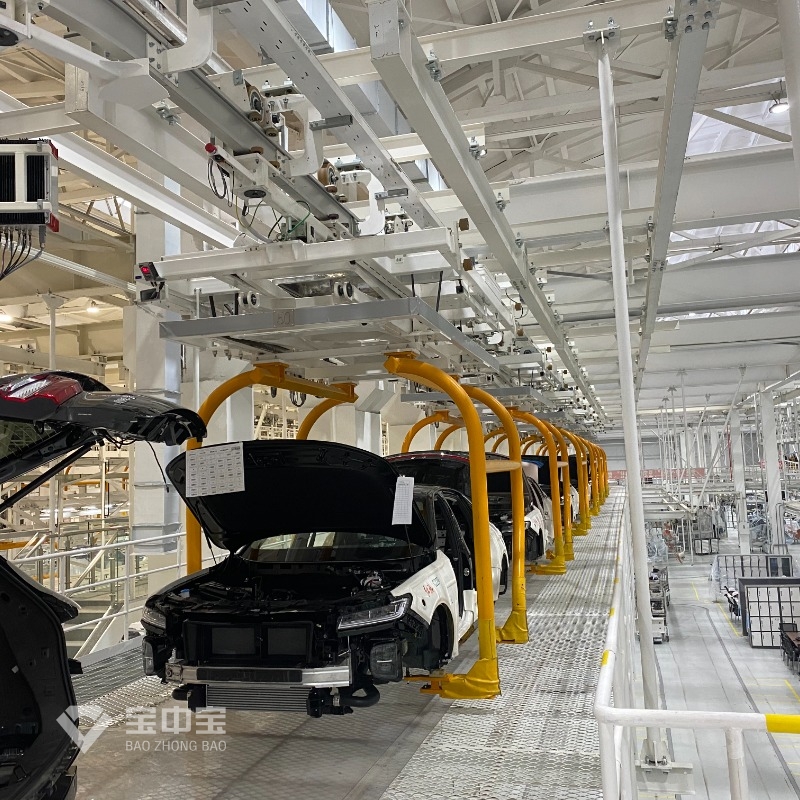
Once the process routes are clear, develop a layout that keeps people, parts, and maintenance access moving safely. Consider conveyor intersections, accumulation zones, booth access, utility distribution, fire protection, and space for future equipment changes.
For mixed-model production, evaluate options such as programmable conveyor speed, flexible carriers, parallel booth lanes, recipe-based controls, and buffer zones before constrained processes. These features can help absorb variation, but each must be checked against footprint, energy use, maintenance complexity, and the required production rate.
We recommend testing the concept with a digital layout or discrete-event simulation. Model normal production, peak color changes, equipment downtime, and the introduction of a new model. A useful planning target may be repeatable carrier positioning within 0.01 mm at a defined interface, but the required tolerance must be established from the actual fixture, robot, and process needs—not assumed for every line.
Robot and applicator selection should reflect body geometry, coating properties, transfer efficiency, and the number of colors and variants. Review robot reach, payload, cycle time, atomizer type, bell or gun configuration, and maintenance access together.
For a flexible coating line, define:
Recipe management is essential. The production system should identify the body and call up the approved process parameters, while preventing unauthorized edits. Validate recipe selection and barcode or RFID traceability before ramp-up.
A new booth cannot compensate for unstable pretreatment or an unsuitable cure profile. Confirm that each substrate and coating combination has a defined process window, then assess the equipment needed to hold it consistently.
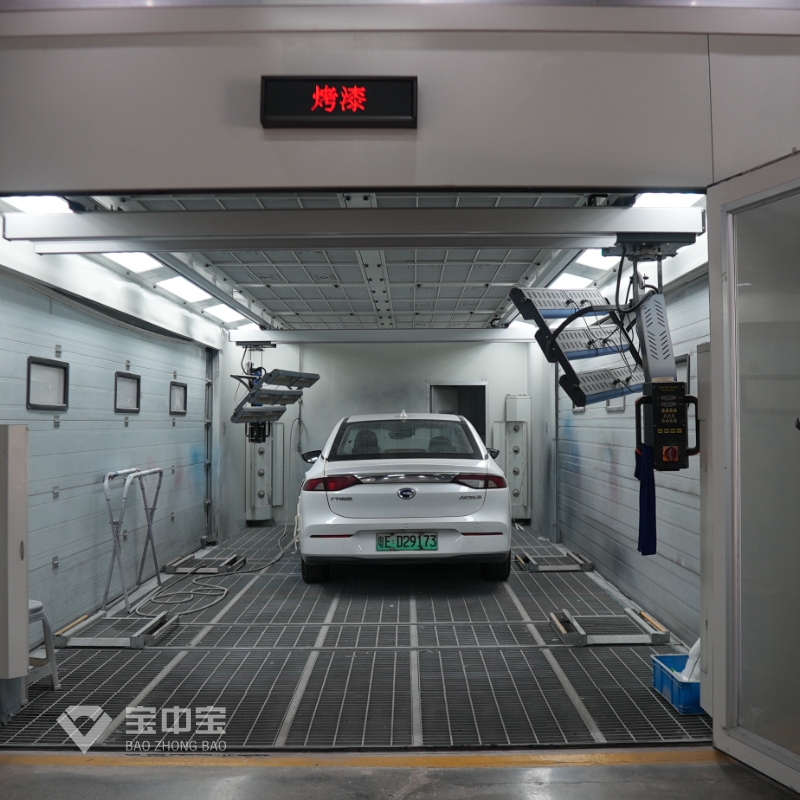
Review water quality, bath control, filtration, compressed air, natural gas or electrical capacity, exhaust, make-up air, and wastewater treatment. Estimate energy and consumable demand at both average and peak production. For ovens, confirm that the workpiece—not only the oven air—reaches the specified metal temperature for the required duration.
Use coating supplier technical data and representative parts to establish process settings. Do not transfer a cure schedule or pretreatment recipe from one material or model to another without validation.
Translate customer appearance and durability requirements into inspection methods, sampling frequency, and reaction plans. A practical control plan may combine automated monitoring with laboratory or manual tests.
Depending on the coating and customer specification, relevant methods may include:
These references are test methods, not blanket acceptance criteria. Confirm the applicable method, conditioning, rating, and limits with the customer and coating specification before production.
Set measurement-system requirements and calibrate instruments on a defined schedule. At launch, consider 100% inspection for selected critical characteristics—such as color-code verification or presence of a required coating—until process capability and defect trends justify a different sampling plan. Track first-pass yield, rework, film build, color deviation, gloss, and defect Pareto by model and color.
A sound design can still underperform if commissioning is rushed. Use a staged acceptance plan that moves from equipment checks to process validation and controlled production trials.
Assign owners to every open issue. For example, a project team can set a 24-hour response target for production-stopping commissioning issues, while defining separate response times for noncritical defects. This is a project-management target, not a universal service guarantee.
| Challenge | Why it happens | Practical response |
|---|---|---|
| Model mix changes after equipment is specified | Forecasts and product launches evolve | Agree on design assumptions, reserve tie-in space, and review the mix at design gates |
| Color changes consume more time than expected | Purge sequence and paint recovery were underestimated | Simulate the color sequence and verify purge volumes during trials |
| Cure quality varies between models | Part mass, geometry, and line loading affect heat transfer | Instrument representative parts and validate the metal-temperature profile |
| The line meets takt only under ideal conditions | Downtime, rejects, and maintenance were excluded | Model availability, changeovers, and quality losses in the capacity plan |
| New automation creates difficult maintenance | Access and spare parts were not included in the design | Involve maintenance early and define critical spares and service access |
| Appearance defects recur without a clear cause | Process data is disconnected from model and recipe records | Link inspection results to body ID, color, recipe, and station data |
The right tools help the team test assumptions before committing to construction. Consider using:
Jingzhongjing Group can use these planning inputs to structure an Automotive Painting System project around the buyer’s product mix, process requirements, and production objectives. Confirm each technical scope, performance target, and acceptance criterion with the project team before equipment selection or contract approval.
Before moving into detailed engineering, confirm that your team has:
The most effective answer to How to Plan an Automotive Painting System for Mixed-Model Production is to connect product variation, process capability, equipment flexibility, and quality evidence before the design is frozen. Start by building your product-family matrix, identifying the true capacity constraint, and validating the highest-risk coating routes with representative parts.
With those inputs, Jingzhongjing Group can help your team evaluate an Automotive Painting System concept that is practical to operate, measurable to validate, and ready to adapt as your model mix changes. Taking these steps early can reduce avoidable redesign, stabilize finish quality, and give your business a clearer path from engineering approval to reliable production.